Click image to view full screen ← Back to Portfolio
Birth of Death Triptych: Three panels, each [ 65” x 44” ] ; total [ 65” x 164”] · Blackened watercolour, and ink on paper mounted on canvas · [ 2017–2022 ]
This monumental triptych captures the precise instant of death in war: a male figure lies wounded, bleeding from the chest, as his love mourns downward in grief. Death looms over them both, skull inked beside its face—even death wears a mask until the last moment of our lives—with the inscription across the dying man's chest: “Death feeds on love.” A crow and Death's dog wait to strike; the ferry and river of death flow behind, while the damned battle endlessly in the distant background.
The black-and-white side panels frame the scene like sculptures: on the right, offence embodied by a male figure on his toes, axe raised to strike again, weight forward—his choice to fight sealing the fall into dirt. On the left, defence as a female figure on her heels, spear high but gaze distant—holding position yet unable to act. Both armed, yet the outcome remains unchanged; loss echoes in the survivor.
The work asks how death is born—of ego-driven choices, offence, or inevitable defence—and reminds that loss always follows. Having experienced life leaving and returning to loved ones, “this changes everything you see and feel.” Five years in the making, the layers reveal truth beneath the mask—dark, yet carrying the seed of rebirth and eternal optimism.
Inquiries welcome for acquisition, studio view, or related works: blairaiken@raincage.com
Inspiration & Personal Connection
This painting draws inspiration from Joachim Patinir’s *Landscape with Charon Crossing the Styx* (c. 1515–1524), which I first saw at the Museo del Prado in Madrid. Patinir’s haunting image of the solitary ferryman guiding souls across the dark waters of the Styx has stayed with me ever since — the quiet finality of the crossing and the weight of what must be left behind.
I have faced death many times in my life, including while living in Madrid during a series of terrorist bombings. Those experiences deepened my understanding of the moment Patinir captures: the soul’s quiet realization that there is no turning back, the ferryman’s silent authority, and the heavy stillness of surrender.
The woman supporting him at the moment of his death is really the key to *The Birth of Death* painting. She represents the quiet strength and love that can exist even in the darkest crossing. The blackening layers trace the slow accumulation of life’s consequences as they are carried into the underworld. Yet even in this darkest crossing, a faint gleam persists on the surface of the water — a quiet reminder that every ending is also a passage, and something essential of the self may still endure beyond the river.
Dark yet hopeful.
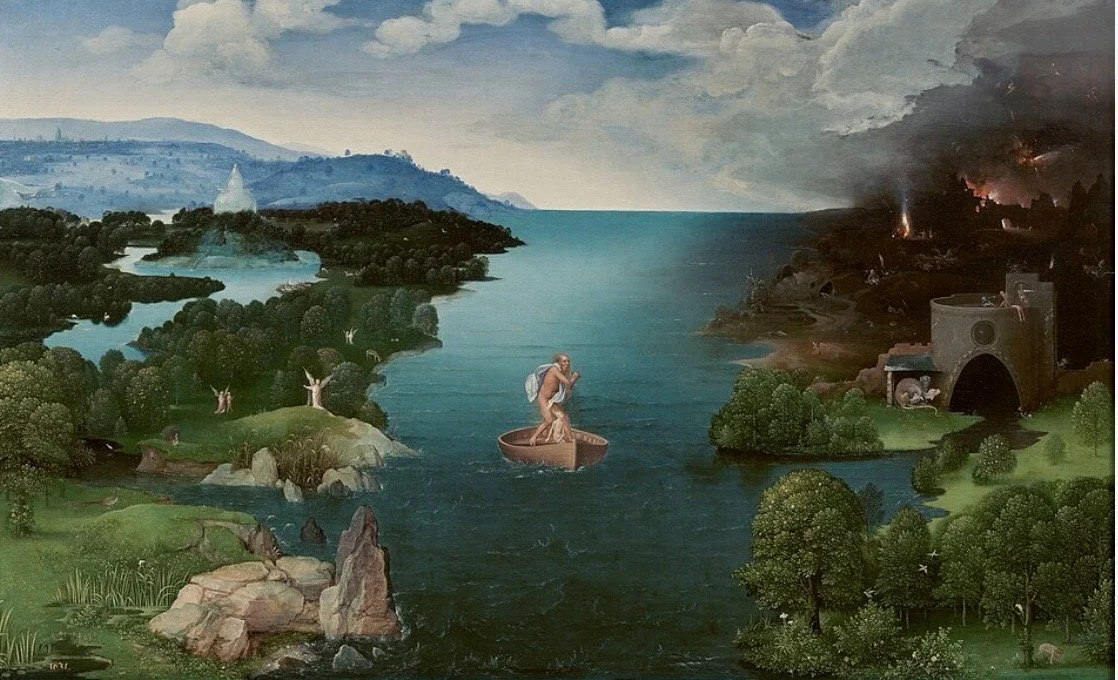
Joachim Patinir’s *Landscape with Charon Crossing the Styx* (c. 1515–1524),